
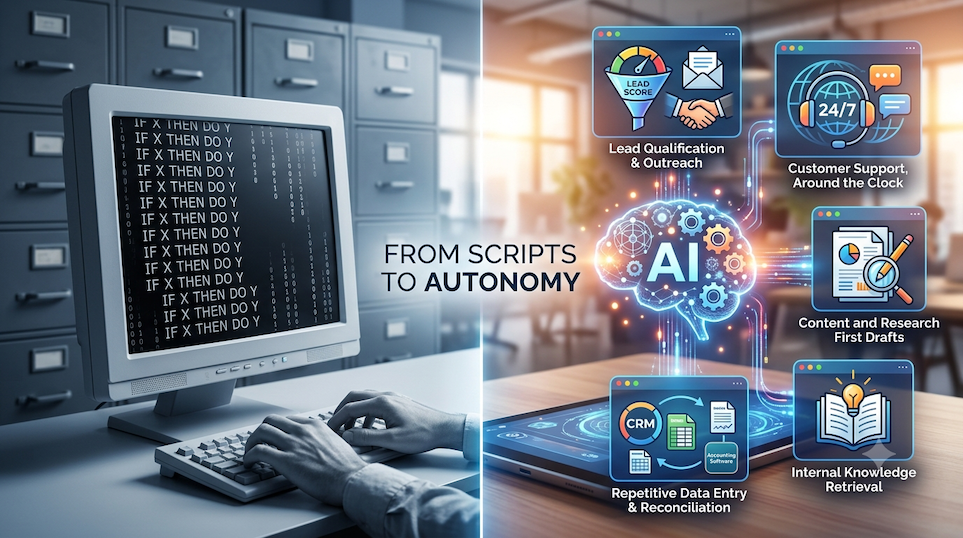
For most of the last decade, "automation" meant rigid, rule-based scripts: if X happens, do Y. The moment a task required judgment, context, or a bit of nuance, automation broke down and a human had to step back in.
AI agents change that equation. Instead of following a fixed script, they reason through a task, use tools and data to gather context, and adapt their approach based on what they find. That shift — from scripted automation to genuine autonomy — is why agents are showing up in so many parts of the business at once.
Here are five places where that shift is already paying off.
1. Lead Qualification and Outreach
Sales teams used to spend hours a day just figuring out which leads were worth a call. An AI sales agent can score incoming leads against your ideal customer profile the moment they arrive, draft a personalized first message based on real signals like recent funding or hiring activity, and hand off only the warm, qualified conversations to a human closer.
The result isn't just time saved — it's more consistent follow-up. Agents don't forget to respond, and they don't have an off day.
2. Customer Support, Around the Clock
Support agents can now handle a meaningful share of inbound tickets end-to-end: understanding the issue, pulling relevant account context, and either resolving it directly or routing it to the right human specialist with full context attached. For global teams, this also solves the timezone problem — your support desk effectively never sleeps.
3. Content and Research First Drafts
Research-heavy tasks — competitive analysis, market summaries, first-draft copywriting — are a strong fit for agents because the work is bounded and the output can be checked before it's used. Teams are using agents to produce the first 80% of a piece of research or content, then having a human refine and approve the final 20%.
4. Repetitive Data Entry and Reconciliation
Anywhere data needs to move between systems that don't talk to each other natively — CRM to spreadsheet, invoice to accounting software — is prime territory for an agent. These are the tasks nobody enjoys doing manually, and they're exactly the kind of well-defined, rules-plus-judgment work agents handle reliably.
5. Internal Knowledge Retrieval
Instead of a teammate pinging five people to find an answer buried in a doc from eight months ago, an agent with access to your internal knowledge base can retrieve and synthesize the answer in seconds. This alone can save a surprising number of hours across a team each week.
The Bigger Shift
None of this means agents replace judgment, strategy, or relationships — the things that still need a human. What it means is that the repetitive, well-defined work that used to consume a huge share of the day can now run in the background, freeing people to spend their time on the parts of the job that actually need them.
That's the real promise of AI agents: not replacing your team, but giving them back the hours that busywork used to quietly take.
No comments yet — be the first to share your thoughts.