
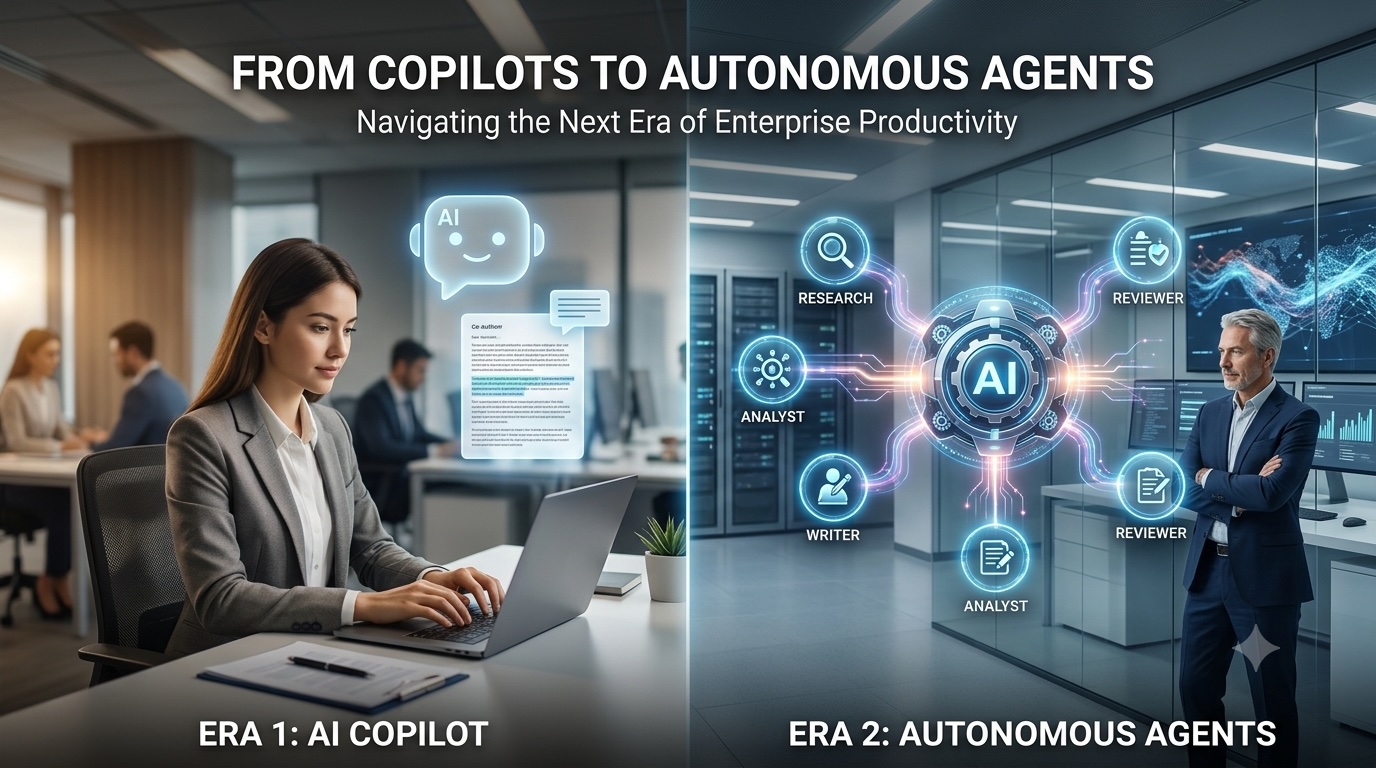
Over the last few years, enterprise AI adoption focused heavily on "copilots"—AI assistants designed to work side-by-side with humans. Copilots summarize meeting transcripts, suggest code completions, and draft email responses. However, while copilots boost individual efficiency, they still rely on constant human prompt engineering and supervision.
We are now moving into the next paradigm: Autonomous AI Agents. Instead of acting merely as real-time writing partners, agents are designed to take end-to-end responsibility for entire business workflows.
The Copilot Bottleneck
Copilots excel at isolated, micro-level tasks. However, operating with a copilot requires a human to remain in the loop for every sequential step:
Human asks copilot to summarize data.
Human reviews output and writes a new prompt to draft a report.
Human copies the report into an email and hits send.
While faster than doing everything manually, the human remains the primary workflow engine and operational bottleneck.
What Makes an Agent Autonomous?
An autonomous agent operates on intent rather than step-by-step instruction. When assigned a high-level directive—such as "Analyze last quarter's churn rate, identify top contributing factors, and draft a summary for the executive team"—an agent executes through three core capabilities:
Decomposition: Breaking down complex directives into multi-step execution plans.
Tool Access & Interoperability: Interacting directly with external software (CRMs, SQL databases, email systems, and analytical tools) via APIs.
Self-Correction: Evaluating intermediate outputs against the primary objective and adjusting its path without requiring human intervention.
The Multi-Agent Enterprise
As autonomy grows, organizations are deploying multi-agent architectures. Rather than relying on a single monolithic model, companies utilize specialized agents operating in coordination:
Research Agent: Scrapes market trends and pulls database metrics.
Analyst Agent: Evaluates data patterns and calculates KPIs.
Writer Agent: Synthesizes findings into formal executive briefings.
Reviewer Agent: Checks for compliance, factual accuracy, and alignment with corporate tone.
In this model, human oversight shifts from execution to governance and strategy. Humans set business goals, define security boundaries, and evaluate macro outcomes while the agent fleet handles operational execution.
Navigating the Transition
Transitioning from copilots to autonomous agents requires a shift in technical and organizational mindset:
Shift from Prompts to Objectives: Define operational outcomes clearly rather than writing granular step-by-step prompts.
Standardize API and Tool Access: Ensure internal tools, databases, and APIs are structured so autonomous agents can safely query and write data.
Establish Guardrails: Define clear permission boundaries specifying what agents can execute independently versus what requires explicit human sign-off.
The enterprise winner of the next decade won't just be the company whose employees use AI assistants to type faster—it will be the organization that builds scalable, autonomous agent fleets to handle complex operational processes end-to-end.
No comments yet — be the first to share your thoughts.